
Last updated September 10, 2026
Full 25-point door and opener safety check with every visit - springs, cables, rollers, tracks, and your LiftMaster or Chamberlain opener included
You get a price before we start. It does not change when the truck arrives.

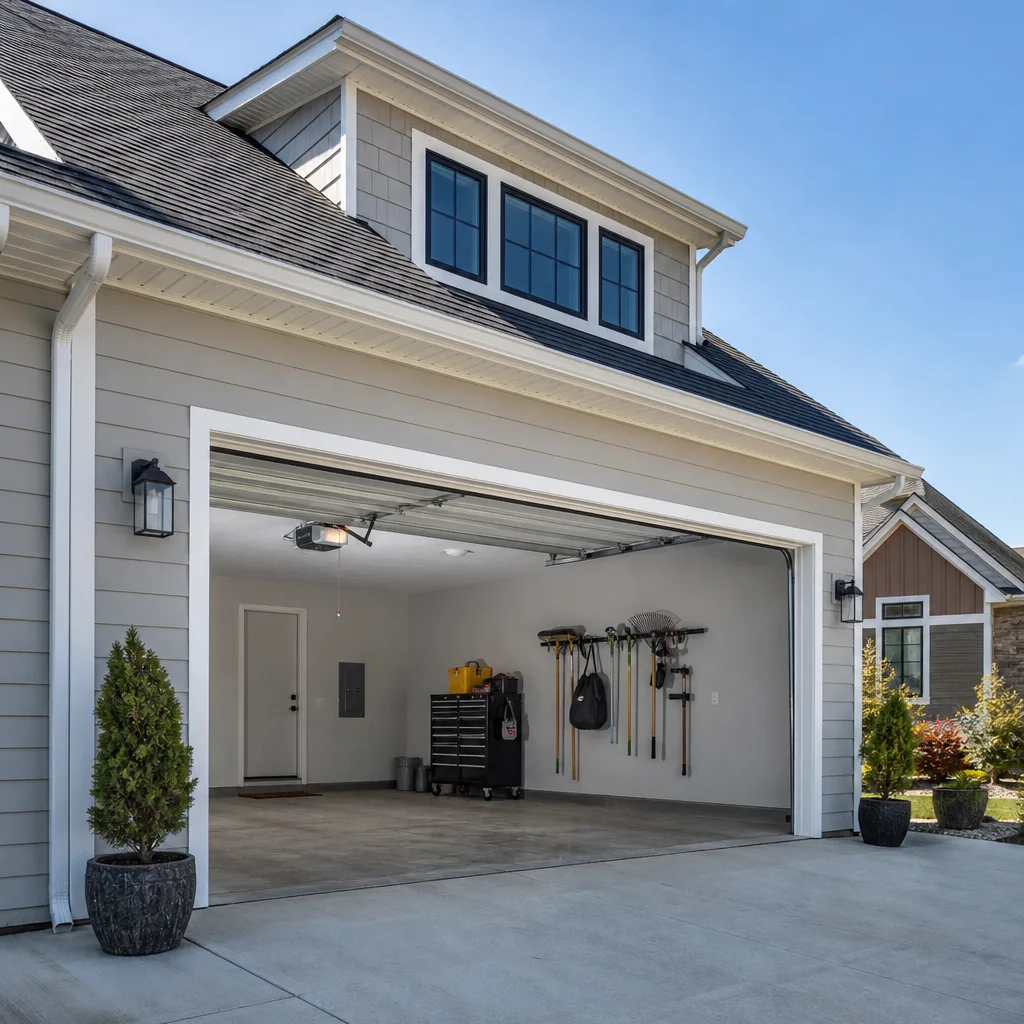
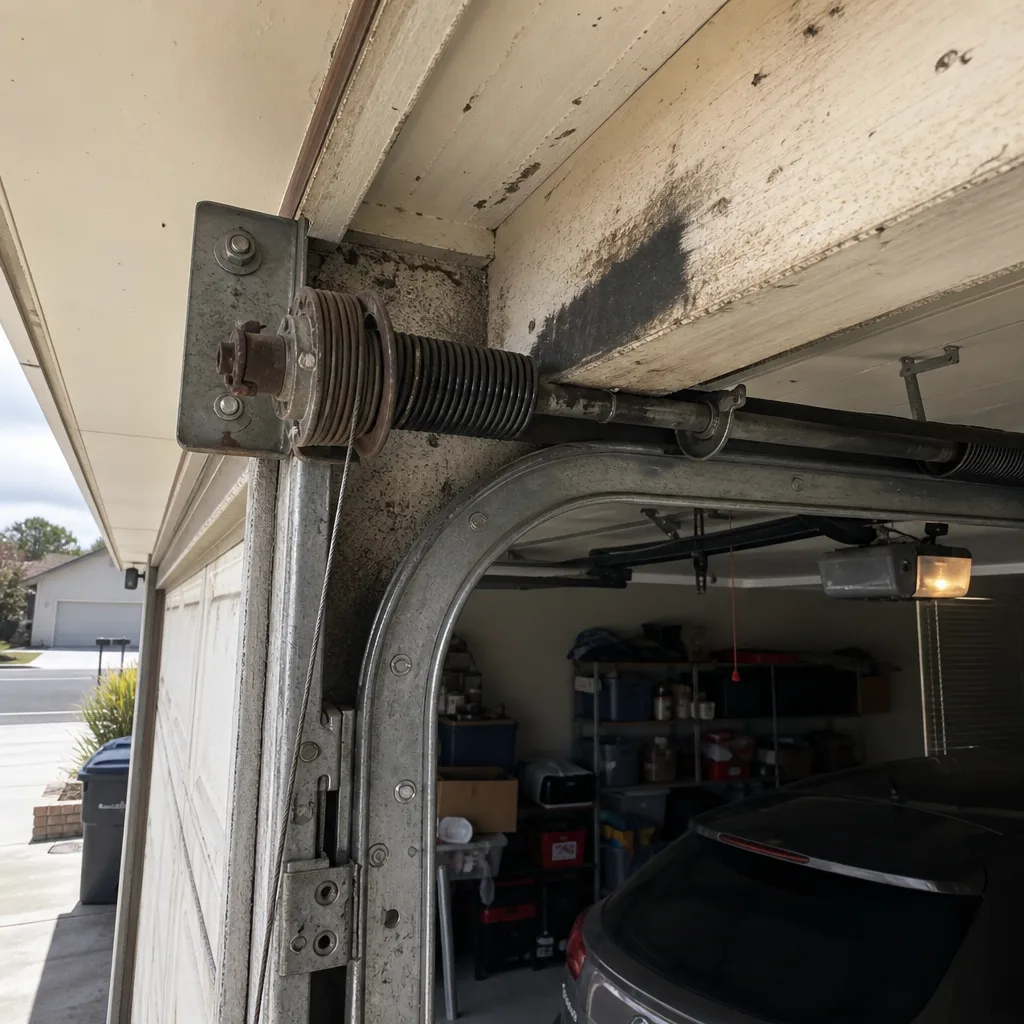 Before
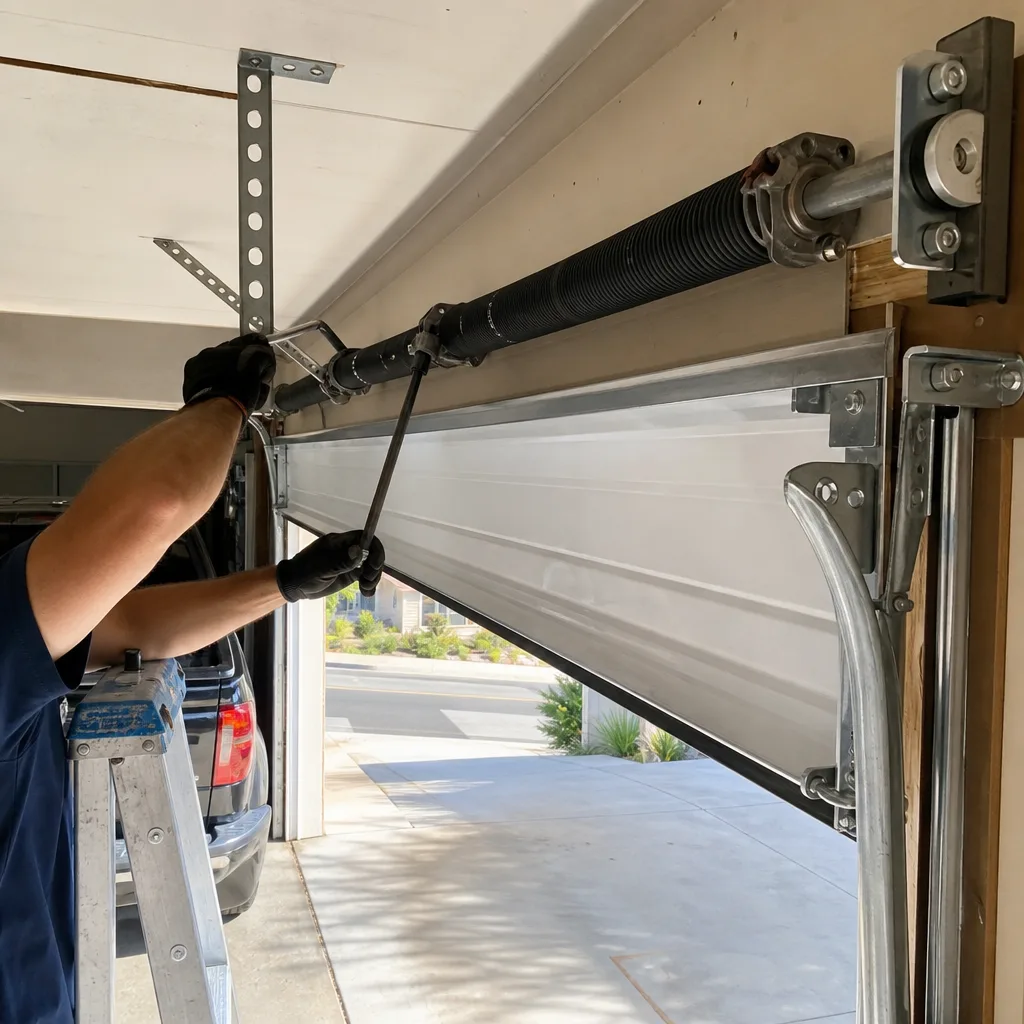 After
After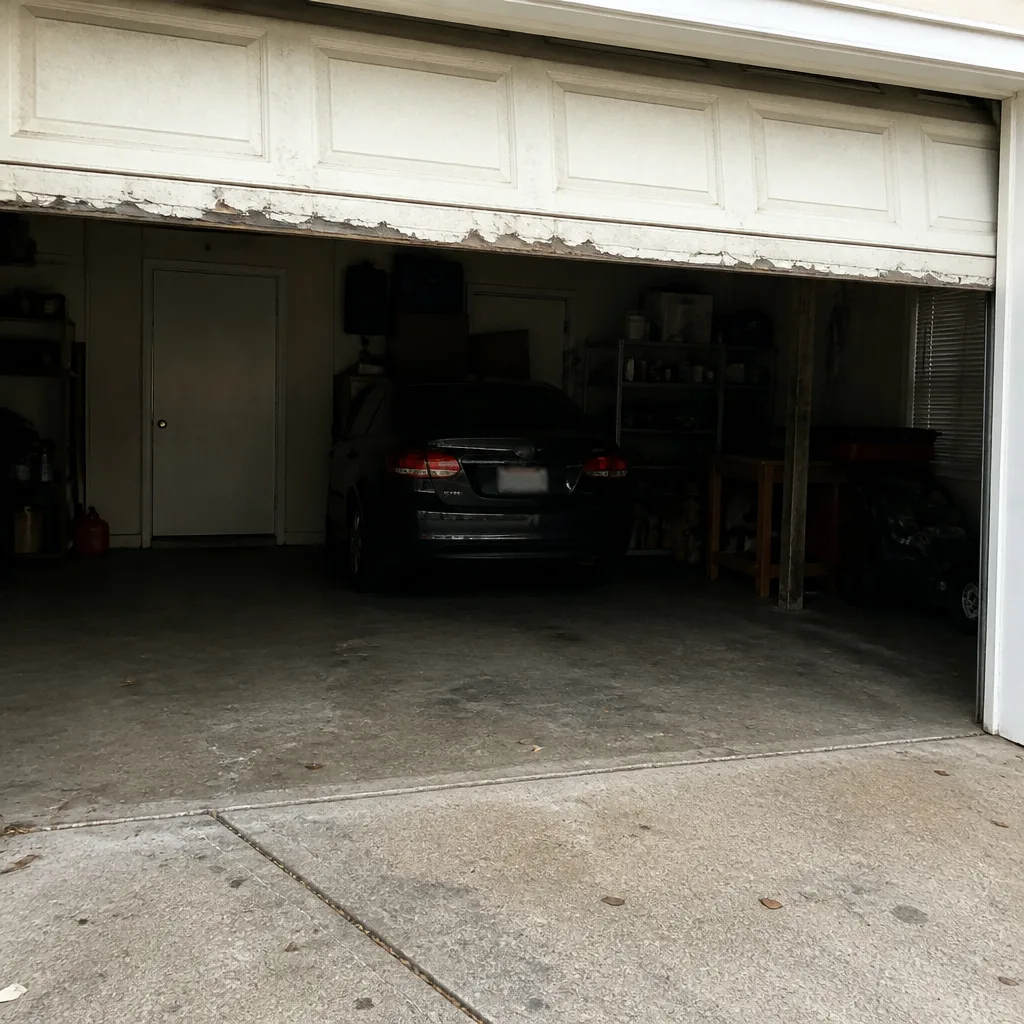 Before
 After
After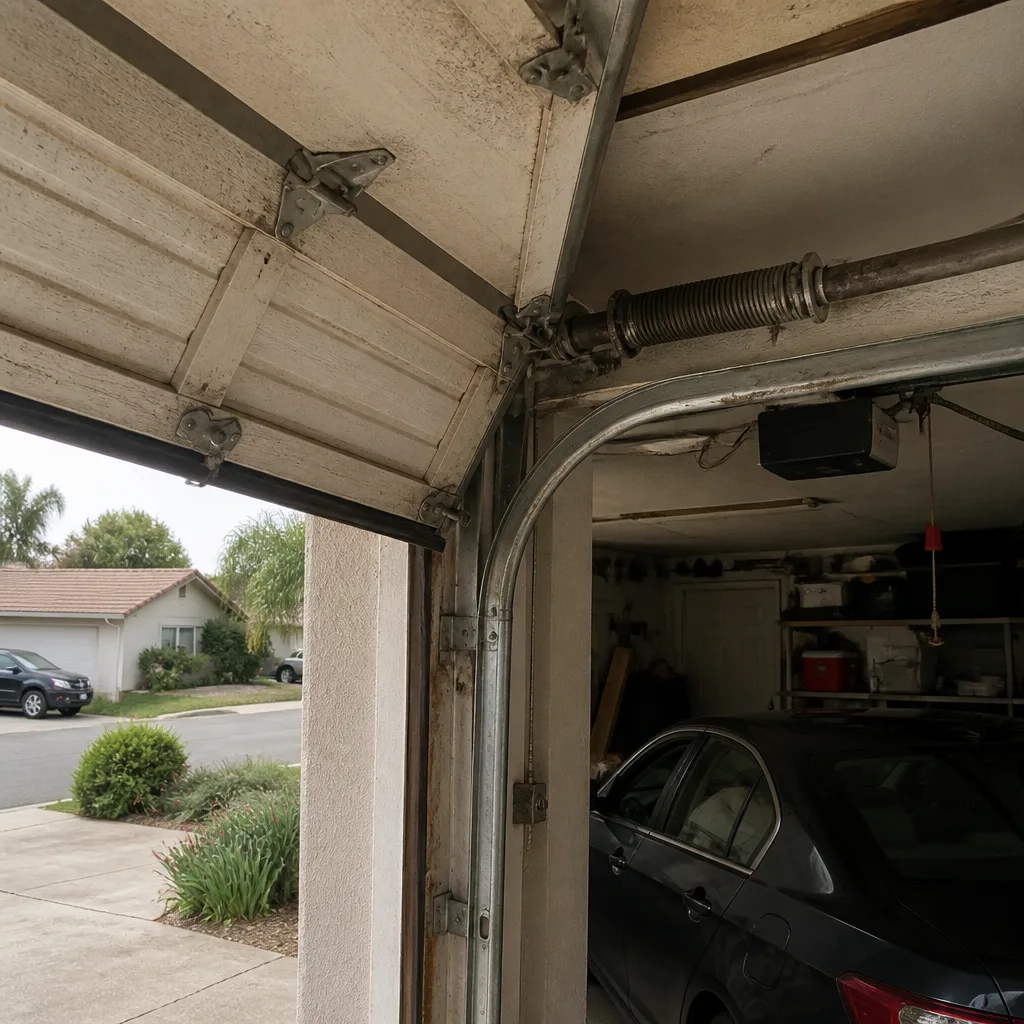 Before
 After
AfterDIY vs Professional Garage Door: The Vista Homeowner’s Decision Guide
A torsion spring on a standard 16-foot garage door holds roughly 45,000 pounds of torque energy at full wind. That is not a warning label number, it is what a high school physics class calls potential energy. When that spring lets go, the energy releases in under a second. So the DIY-vs-pro question was never about how handy you are. It is about which five or six garage door jobs carry that level of stored force, and which fifteen or twenty others are genuinely safe for a Vista homeowner with a socket set and a Saturday. This guide draws that line based on the actual mechanism and the real injury data, not liability boilerplate.
Here is what you will get: a definitive task list for what you can do yourself, a plain explanation of why springs are the one part you do not touch, and a cost breakdown for the three repairs Vista homeowners most often try to DIY. By the end, you will know exactly when to grab the toolbox and when to pick up the phone.
Quick Answer
Garage door DIY is safe and sensible for jobs like weatherstripping, lubrication, sensor alignment, and remote programming. You need a professional for anything involving torsion springs, lift cables, full door installation, or trolley replacement. The line is not your skill level. It is the amount of stored mechanical energy in the part you are about to touch.
Table of Contents
- What You Can Safely DIY
- What Requires a Licensed Tech
- Why Torsion Springs Are Different
- Cost-Benefit Analysis: The Three Most Common DIY Temptations
- The Wrong Spring Mistake We See Most Often in Vista
- Signs You Have Crossed the Line Mid-Project
- The Right Tools for DIY Jobs
- Common Mistakes to Avoid
- When to Call a Professional
- Frequently Asked Questions
- The Bottom Line
What You Can Safely DIY
Some garage door maintenance work requires almost no mechanical knowledge and carries zero risk of stored-energy injury. In Vista, where coastal air and inland heat cycles put constant stress on seals and rollers, these tasks come up more often than most homeowners expect. These are the jobs we tell people to do themselves, because calling a technician for them is like calling an electrician to change a light bulb.
Weatherstripping and Bottom Seal Replacement
The rubber strip along the bottom of your door rots, cracks, and flattens over time. In Vista’s summer heat, a 10-year-old seal turns brittle and lets dust, bugs, and garage-cooled air escape. Replacing a bottom seal costs about $8 to $20 for the material at any hardware store, and it slides into a track or screws on with self-tapping screws. The job takes 30 minutes and requires no spring tension work. You never remove the door from its tracks. You never touch a cable. The door stays connected the entire time.
Lubrication
Garage door rollers, hinges, and tracks benefit from lubrication twice a year. Use a white lithium grease on hinges and a silicone spray on rollers and tracks. Do not use WD-40. It is a solvent, not a lubricant, and it strips away the protective grease that keeps your rollers turning quietly. In Vista’s dry inland climate, neglected rollers seize up faster than you would think, especially on older homes in Shadowridge or near Buena Creek where garage dust is a constant. A $6 can of silicone spray saves you a $45 service call, and the job takes ten minutes.
Sensor Alignment
Those two black boxes near the floor on either side of your door are photo-eye sensors. If one gets nudged by a bicycle tire or a bag of potting soil, the door refuses to close or reverses halfway down. Most sensor alignment issues are fixable in five minutes. Loosen the wingnut on the sensor bracket, level it with the other sensor, tighten, and test. The sensors should face each other directly, with their small indicator lights glowing steady. This is a task anyone can do safely because there is no tension on the system. The door is not connected to the opener when you are working at floor level.
Remote and Keypad Programming
Programming a new remote or keypad for a LiftMaster, Chamberlain, Genie, or Craftsman opener takes five minutes. Every opener has a “Learn” button on the motor unit, usually near the antenna wire. Press it, then press the remote button, and you are done. Keypads take an extra step: enter a four-digit PIN after pressing Learn. The instruction manual is online if you lost it, and no special tools are required.
Paint Touch-Up and Cosmetic Cleaning
Galvanized steel doors with minor scuffs can be touched up with matching paint. Clopay and Amarr sell color-matched touch-up paint through their dealers. Washing the exterior with mild soap and water twice a year extends the finish. None of this touches the mechanical system.
These five categories cover about 60% of the phone calls we get. Homeowners handle them without issue, and honestly, we are glad they do. It keeps the service calendar open for the jobs that actually require a trained hand.
What Requires a Licensed Tech
There are four garage door jobs where the risk of serious injury or property damage is high enough that a professional is the only responsible choice. We are not talking about comfort level. We are talking about parts that store enough energy to break bone.
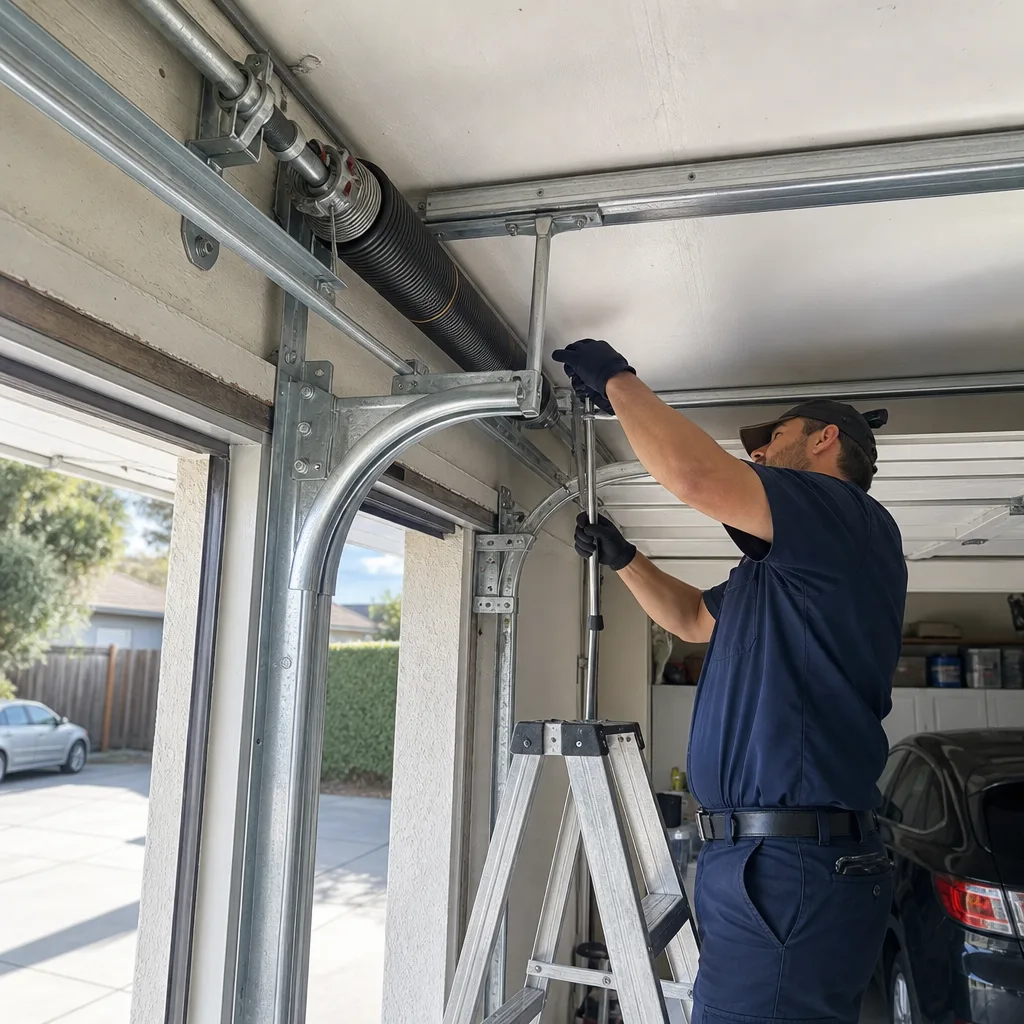
- Torsion spring replacement. Torsion springs are mounted on a rod above the closed door. Each spring is wound with a specific number of turns to counterbalance the door’s weight. When a spring breaks, it releases stored energy violently. Replacing one requires winding bars, precise quarter-turn counting, and an understanding of door weight versus spring torque. A mistake here can send a winding bar through the air at lethal speed.
- Extension spring and cable replacement. Extension springs stretch along the horizontal tracks. When they fail, the cable and spring act like a slingshot. Safety cables are required, but even with them installed, the replacement process puts your hands and face directly in the line of stored tension.
- Full door installation. A new garage door weighs 150 to 400 pounds depending on material and insulation. Installation requires a level floor, properly aligned tracks, correctly torqued springs, and precisely adjusted cable tension. One misaligned track and the door binds, bends, or falls.
- Trolley and rail replacement. The trolley is the carriage that moves along the opener rail, pulling the door up and down. Replacing a trolley means removing the opener rail from the ceiling, which is heavy, awkward work above your head. Most people are not positioned to do this safely from a ladder.
Each of these jobs involves a component under either mechanical tension or gravitational load. This is the line. It is not about whether you are handy. It is about what happens to the part when it fails, and whether your hands are in the path.
Why Torsion Springs Are Different
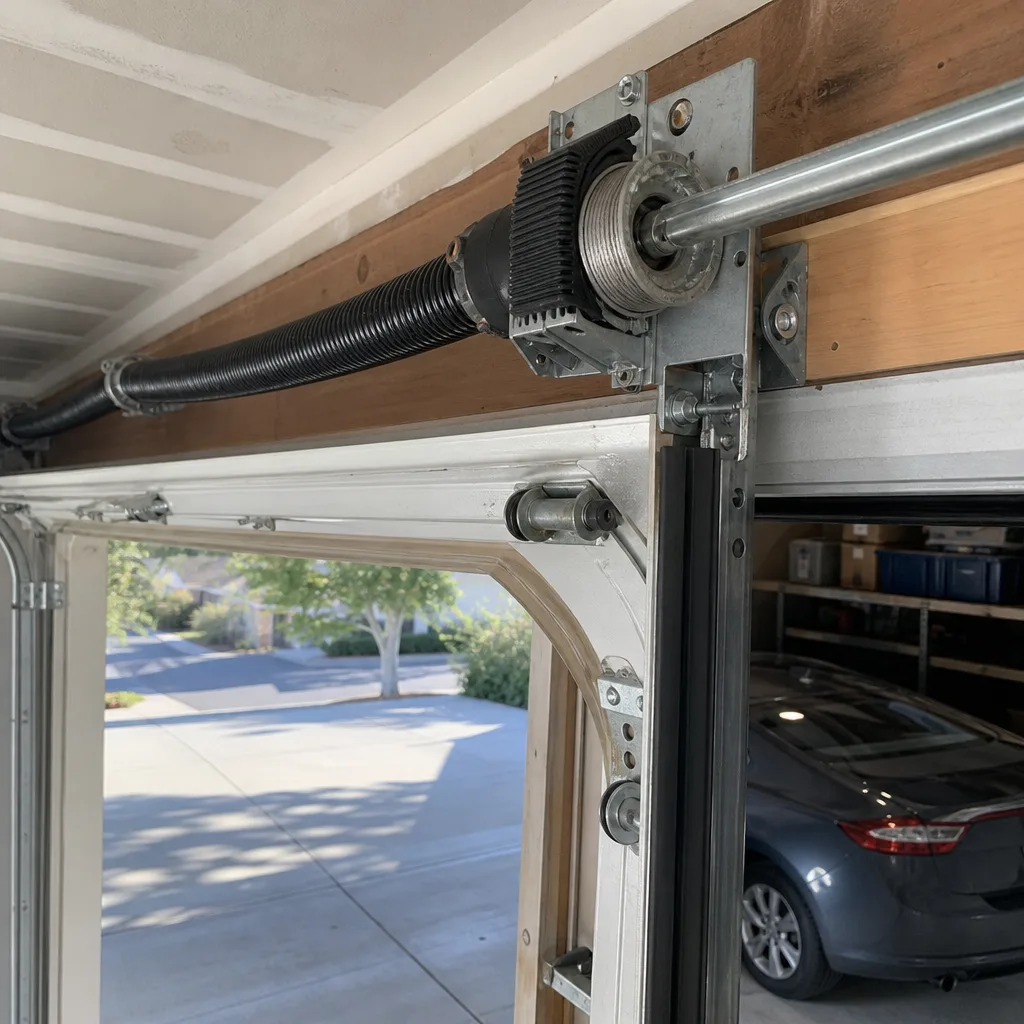
A torsion spring does not look dangerous. It is a steel coil, maybe two feet long, mounted on a rod above your head. You see it every time you park the car. It sits there, inert, coiled tight. The danger is invisible because the energy is stored inside the coil, not visible like a stretched rubber band.
Here is how the mechanism works. A standard residential torsion spring is wound between 7 and 9 full turns when the door is closed. Each turn stores about 5,000 to 6,000 pounds of torque on a 2-inch spring. When the door opens, the spring unwinds and releases that stored energy to lift the door. When the spring breaks, it is usually while the door is down, with maximum tension wound. The break is instant. The spring does not slowly unwind. It snaps, and the loose ends spin at high speed. A spring end has the mass of a small hammer and the speed of a thrown baseball. That combination goes through drywall. It breaks wrists, fingers, and forearms. We have seen the aftermath in Vista garage ceilings more times than we care to count.
This is not a scare tactic. It is the physics of a part that does its job 10,000 to 15,000 times before it fails. Every spring has a cycle life rating, just like tires have a mileage rating. A door opened four times a day for seven years puts about 10,000 cycles on a spring. When we repair a door, we count the spring cycles and tell the homeowner what is left on theirs.
The other reason torsion springs are professional-only work is calibration. The spring must be wound to match the exact weight of your door, not the weight of the old spring. A door with a new opener, added insulation, or different panels has a different weight than the door that spring was originally installed on. Get the calibration wrong and the door is under-sprung or over-sprung. Under-sprung means the opener works harder and burns out its motor. Over-sprung means the door wants to fly up, which is dangerous and wears out the spring prematurely. A professional measures the door with a tension gauge and winds the spring to match. DIYers usually just count the old spring’s turns and hope the door weighs the same. It rarely does.
Cost-Benefit Analysis: The Three Most Common DIY Temptations
Here is the honest math on the three repairs Vista homeowners most often attempt themselves, with a full Garage Door Cost Breakdown: The Vista Homeowner’s Reference for 2026. We have priced these out based on what we have seen in the area over the past several years, and what a typical homeowner spends at the hardware store or online.
| Situation | DIY Cost | Pro Cost | Time | Risk | Worth DIYing? |
|---|---|---|---|---|---|
| Bottom seal replacement | $8 to $20 | $85 to $130 | 30 min | None | Yes |
| Opener keypad install | $25 to $60 | $110 to $160 | 20 min | None | Yes |
| Panel dent repair | $30 to $80 for filler and paint | $140 to $350 depending on panel | 2 to 3 hours | Low | Sometimes |
Bottom Seal Replacement
The bottom seal, sometimes called a weatherstrip or astragal, is a U-shaped rubber strip that clips or slides into a retainer along the bottom of the door. DIY cost is under $20 for a universal seal at any hardware store in Vista. The job is: close the door, remove the old seal, slide in the new one, cut to length, done. No tension, no ladders, no special tools. A professional charges for the callout plus the part, so around $85 to $130. Unless you physically cannot kneel, this is a DIY job every time.
Opener Keypad Install
A wireless keypad costs $25 to $60 on Amazon or at a local store. Installation is: screw two screws into the wall near the door frame, insert the battery, press Learn on the opener, enter a PIN. Twenty minutes. Same result as a $110 to $160 service call. DIY every time.
Panel Dent Repair
This is the judgment call. A dented panel on an old, uninsulated steel door can sometimes be banged out from the inside and touched up with paint. Cost: $30 to $80. Time: two to three hours. Result: depends on scale. Small dents, okay. Large creases or punctured panels on an insulated door are not fixable with body filler. The panel needs replacement, and replacement panels are not sold individually for most door models; you have to order through a dealer, and the cost gets close to a full door replacement. If the dent is bigger than a dinner plate, you are buying a new panel or a new door. For that you want a professional quote, not a Saturday project. This is where a Garage Door Repair in Vista professional can tell you honestly whether the door is worth saving or you should put that money toward a new one.
The Wrong Spring Mistake We See Most Often in Vista
If there is one DIY failure we see repeatedly in Vista garages, it is this: a homeowner breaks a torsion spring, goes online, finds a replacement spring that “looks the same,” measures the old spring with a tape measure, and orders it. The new spring arrives, they install it, and two weeks later the door is acting up again. The spring has failed or the door is unbalanced.
The mistake is understandable. The old spring is right there, and measuring it seems like the logical thing to do. But a spring’s internal diameter, wire gauge, and length must be matched to the exact weight of the door, not to the dimensions of the spring that was on there before. If the previous spring was wrong, or if the door has had panels, insulation, or struts added since that spring was installed, the new spring’s torque will not match the door’s weight. A spring that is under-wound fails prematurely because it works too hard. A spring that is over-wound makes the door shoot up and slam the opener carriage into the stop bolt. Both scenarios ruin the new spring and strain the opener motor. We have seen homeowners in Vista spend $80 on a spring, break a sweat installing it, and then call us when the door starts slamming shut on the third day. By then the new spring is already damaged and has to be replaced again, this time with the correct one.
Spring selection is not a measurement problem. It is a calculation problem. It involves door height, door width, door weight, track radius, and drum size. Most residential doors in Vista are 7 feet tall and 16 feet wide, but the weight varies by 40 to 80 pounds depending on whether the door has insulation, steel thickness, struts, or windows. A professional weighs the door with a spring scale before selecting the spring. Anything less is a guess, and a wrong guess on a spring is money down the drain.
Signs You Have Crossed the Line Mid-Project
Every homeowner who attempts a garage door repair eventually hits a moment where the job turns from manageable to risky. It can happen in the middle of what was supposed to be a simple fix. Here are the specific signs that mean you should stop, set the tools down, and make a call.
- The door is off-balance when you lift it halfway. A properly balanced door stays put when lifted to waist height and released. If it drops or shoots up, the spring tension is off. Continuing to work on a door with incorrect tension is working against stored energy.
- You see a frayed cable or a gap in the spring coil. Frayed cables mean the lift cable is about to snap. A gap in a torsion spring coil means the spring has already broken and the two halves are resting under partial tension. Do not touch either one.
- You are using a screwdriver or pipe as a winding bar substitute. The only safe tools for winding a torsion spring are solid steel winding bars that fit the winding cone snugly. Anything else can slip out and become a projectile. If you are holding anything other than the proper bar, stop.
- You are on a ladder with your face near the spring rod. If your face is within arm’s reach of the spring while it is under tension, you have already crossed the line. A spring end that lets go at that distance will not give you time to duck.
- You have removed more bolts than the job requires. This sounds obvious, but it happens. A homeowner starts with a simple roller replacement and suddenly the track bracket is loose, the door is leaning, and the tension has shifted. If the door is no longer sitting level in the tracks, the project is over. Re-leveling a door under tension is professional work.
- You have been working for two hours and the door does not work better than when you started. At this point you are not saving money. You are burning a Saturday and possibly making the problem worse. A service call is cheaper than a second service call to fix your first attempt plus the original problem.
We have taken dozens of calls that started with “I was just going to…” and ended with us re-hanging a door that came off its tracks. There is no shame in knowing where the line is. The line is what keeps you out of the ER.
The Right Tools for DIY Jobs
If you are going to handle the safe DIY jobs, these are the tools that make them go smoothly. None of these are specialized garage door tools. Every one of them is in a standard homeowner toolbox or available at any hardware store for under $30.
- White lithium grease and silicone spray. One for hinges, one for rollers and tracks. Do not interchange them. Do not use WD-40.
- Adjustable wrench and socket set. Sensor brackets, track bolts, and seal retainers all use standard sizes. A 7/16, 1/2, and 9/16 socket covers most residential garage door hardware.
- Level. Sensor alignment requires a level surface. A 24-inch level is enough.
- Utility knife and tin snips. For cutting bottom seal to length. Tin snips make a cleaner cut than a hacksaw on rubber and aluminum retainer tracks.
- Step stool or short ladder. For lubrication and track inspection. Keep your feet on the ground or on a stable step stool. Do not climb onto the door itself or lean against it while it is under tension.
- Gloves and safety glasses. Minor job, but old rollers shed metal shavings, and dried rubber crumbles into your face when you pull an old seal.
None of these tools will help you with a torsion spring, and that is the point. The tools required for spring work are steel winding bars and a torque wrench, and if you do not already own them, that is your sign to call someone who does.
Common Mistakes to Avoid
- Using WD-40 on rollers and hinges. It strips grease and accelerates wear. Use silicone spray on rollers and white lithium grease on hinges. This is the most common maintenance mistake we see in Vista garages.
- Assuming a spring “looks fine” because it is not broken. Springs wear out by cycle count, not by appearance. A spring with 12,000 cycles on it can look identical to a new one and fail tomorrow. When we do a repair, we tell you what is left on your spring.
- Measuring the old spring instead of the door. Spring selection is based on door weight, height, width, and track radius. Measuring the old spring and ordering the same dimensions is the fastest way to end up with an unbalanced door and a wasted $80.
- Ignoring a frayed cable because “the door still works.” A frayed cable is a cable that will snap, and it will snap when the door is moving, usually with your car under it. Replace frayed cables immediately.
- Reusing old hardware on a new door install. New doors come with new hardware for a reason. Old track, old brackets, and old drums have wear patterns that match the old door. Mixing old with new creates binding, noise, and premature spring failure.
- Winding a spring with a screwdriver. The wing of a screwdriver is not a winding bar. It bends, slips, and launches. If you have reached the point of needing a winding bar, you have reached the point of needing the phone.
- Skipping the safety cable on extension springs. If you have an older door with extension springs and no safety cables running through them, a spring failure becomes a missile hazard in the garage. This is a safety code issue and a real risk to anyone parked or working nearby.
When to Call a Professional
Call a professional when the job involves stored mechanical energy: torsion springs, extension springs, lift cables, or anything connected to them. Call when the door is off its tracks, when the opener rail has come loose from the ceiling, when a panel is punctured rather than dented, or when the door will not balance at waist height. Call when you have already spent an hour on a repair and the door works worse than before. And call when the garage is your only way to get the car out in the morning. If the car is trapped inside, this is not the weekend to learn about spring torque. Otto’s Garage Door offers free estimates in Vista – call (760) 891-5938, and a live person answers, often Otto himself.
For a full picture of what a pro can handle, start with our Otto’s Garage Door home page or the Garage Door Repair in Vista service page. If you are weighing a whole new door versus a repair, the Garage Door Installation in Vista page breaks down what a replacement costs and what factors move the number. And if your opener is the problem, the Garage Door Opener in Vista page covers motor replacement, rail work, and what to do when the opener strains but the door is fine.
Frequently Asked Questions
You should not. Torsion springs hold 45,000 pounds of stored torque energy and release it instantly when they break. Replacing one requires steel winding bars, precise turn counting, and a spring matched to your door’s exact weight. The injury risk is real, and the cost savings are not worth it.
You can safely replace bottom weatherstripping, lubricate rollers and hinges, align photo-eye sensors, program remotes and keypads, and touch up cosmetic paint. None of these jobs involves touching the spring system, cables, or door balance.
Torsion spring replacement in Vista typically runs $180 to $340 for a single spring, including the part and labor. Double-spring systems run $280 to $500. The price is quoted before work starts and does not change at the door. Call (760) 891-5938 for an exact quote on your door.
Look for a separation gap in the spring coil, which means it has already broken. Listen for a loud bang from the garage, like a firecracker. Check whether the door feels heavy when you lift it manually; a door that was easy to lift and suddenly is not has lost spring tension.
Depends on the door’s condition and what is broken. A 20-year-old door from Amarr, Wayne Dalton, Clopay, or Raynor with good panels and a solid track can be worth repairing if the failure is a spring, roller, or opener. If the panels are rusted through or the track is bent, replacement is usually the better value. We give an honest assessment either way.
No trip charge inside our home county. If you have a written estimate from another company, bring it in and we will give you a free second opinion. Quotes are free, and the price quoted on the phone is the price at the door. Call (760) 891-5938 anytime.
The Bottom Line
The DIY-vs-pro decision on garage door work comes down to one question: does this part store enough energy to hurt me if it fails? If the answer is yes, as with springs and cables, the job is professional work. If the answer is no, as with seals, lubrication, and sensors, you can handle it with a $20 trip to the hardware store. Most online content gets this backwards by treating every garage door task as either a liability warning or a YouTube project, but you can find more guides & resources that respect the actual mechanics. The truth is in the mechanism. Respect the spring. Do the seal yourself. Know the difference. That is how Vista homeowners keep their garages working without a hospital visit or a $90 service call for a $10 part.
Written by Otto Reinhardt, Owner at Otto’s Garage Door, serving Vista since 2004.